 Sarah Mitchell, Senior Building Surveyor
Camden's streets of tightly-packed Victorian and Edwardian terraces are beautiful — but they do come with a complication that buyers and homeowners frequently underestimate: the Party Wall Act. I've seen party wall disputes cause significant delays to building projects, damage neighbour relationships, and in a small number of cases, result in serious and expensive legal proceedings.
The good news is that the Act is actually designed to protect everyone involved — not just your neighbours. When it's followed properly, it creates a clear legal framework that prevents disputes from escalating and gives everyone certainty about how building works will proceed. This guide will walk you through everything you need to know as a Camden homeowner.
In This Guide
What is the Party Wall Act 1996?
The Party Wall etc. Act 1996 is a piece of legislation that applies in England and Wales. Its purpose is to prevent and resolve disputes relating to party walls, boundary walls, and excavations near neighbouring buildings. If you're planning to carry out certain types of building work, the Act requires you to notify your neighbours before work begins.
The Act was introduced largely because of the increase in home improvement activity — particularly in London — and the problems this was causing between neighbours. Before the Act, disputes were handled by the common law of nuisance, which was expensive and uncertain. The Act provides a more streamlined mechanism.
What Work Triggers the Party Wall Act?
The Act covers three types of work:
- Line of Junction Notices: New walls built on or at the boundary between two properties
- Party Structure Notices: Works to an existing party wall — including cutting into it, removing a chimney breast from it, exposing it to weather, or raising or underpinning it
- Three Metre/Six Metre Notices: Excavations within three metres of a neighbouring structure (or six metres if the excavation goes deeper than the neighbour's foundations)
In practical Camden terms, this means the Act is almost always triggered by: loft conversions, rear extensions, basement digs (which are very common in Camden's terraced streets), removal of chimney breasts, and any significant work to a shared wall.
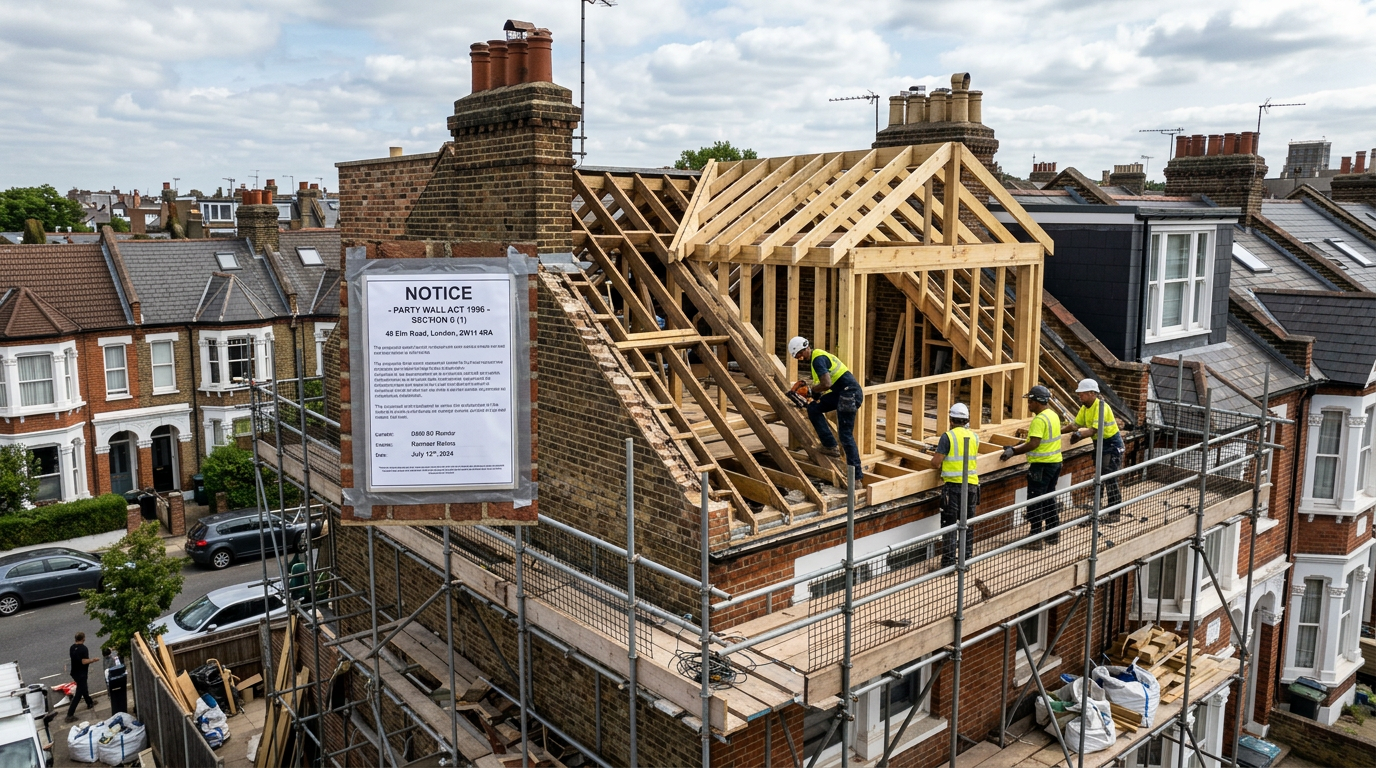
Serving a Party Wall Notice
Before you start any notifiable work, you must serve a formal written notice on your adjoining neighbours. The notice must describe the work you intend to carry out and give your neighbours time to respond. The required notice periods are:
- Two months' notice for party structure works
- One month's notice for line of junction works
- One month's notice for excavation works
The notice must state your name and address, the address of the building, a description of the proposed works, and the date you plan to start. It must be served in writing — either by hand, post, or (with agreement) by email.
You can serve the notice yourself, but many homeowners find it easier and more reliable to ask a party wall surveyor to do it for them. We handle all party wall notice serving as part of our party wall service.
What Happens After You Serve Notice?
Once you serve notice, your neighbour has 14 days to respond. They have three options:
- Consent: They sign to agree the works, and no surveyor is needed (though a schedule of condition is still strongly advisable)
- Dissent: They disagree, and both parties appoint surveyors (or agree on one shared surveyor)
- No response: If they don't respond within 14 days, a dispute is deemed to have arisen and surveyors must be appointed
The Party Wall Award
When surveyors are appointed, they prepare a Party Wall Award — a legally binding document that sets out the rights and obligations of both parties in relation to the works. The Award typically includes:
- A description of the permitted works
- The method and sequence of construction
- Working hours and access arrangements
- Provisions for making good any damage caused
- Details of any security to be provided by the building owner
The Award is binding on both parties. If works are carried out outside its terms, the building owner can be held liable for any resulting damage.
Schedule of Condition
One of the most important documents in the party wall process is the Schedule of Condition — a detailed photographic and written record of the adjoining property's condition before work starts. This is essential because if your neighbour later claims that your work caused damage to their property, the Schedule of Condition provides the baseline evidence to determine whether any deterioration actually occurred as a result of your works.
I strongly recommend a Schedule of Condition even when your neighbour has consented to the works and no Award has been prepared. It protects both parties and can prevent costly disputes later.
Practical Tips for Camden Properties
Here are some specific points that come up regularly in Camden party wall work:
- Camden's basement digs are among the most complex party wall scenarios we encounter. The proximity of neighbouring structures, the variety of subsoils, and the depth of excavation required all require very careful management in the Award.
- Many Camden properties share chimney stacks. Any work to a shared stack — including removal of a flue liner — triggers the Act.
- If your property is mid-terrace, you may need to serve notice on two neighbours.
- Don't start work before the notice period has expired, even if your neighbour is perfectly happy with the works. Starting too early makes the works technically unlawful and can expose you to an injunction.
Party Wall FAQs
In the vast majority of cases, the building owner (the person carrying out the works) pays the surveyor's fees — including the fees of the adjoining owner's surveyor. The exception is where the adjoining owner is making unreasonable demands or obstructing the process, in which case costs can be apportioned differently.
No. The Party Wall Act does not give your neighbour a veto over your building works. They can trigger the surveyor process by dissenting, but the surveyors will then issue an Award permitting the works to proceed, subject to reasonable safeguards. Your right to build (provided you have planning permission where required) cannot be blocked by a neighbour's objection under the Act.
Almost certainly yes, if the extension involves new foundations within three metres of your neighbour's structure, or if the works involve a shared wall. Even a single-storey rear extension usually triggers at least the excavation provisions of the Act. Always check with a party wall surveyor before you start.
Need a Party Wall Surveyor in Camden?
Our experienced party wall surveyors can act for you as building owner or adjoining owner, or as the agreed surveyor for both parties. Get in touch for a free initial conversation.
Get in Touch