 Emma Davies MRICS, Residential Surveyor
Your building survey report has arrived. It's forty pages long, full of technical terminology, and the condition ratings are ranging from green to red on what feels like everything. You're sitting at your kitchen table wondering whether you should still buy this property or whether you've just discovered a money pit. I've been in this situation with hundreds of clients, and I can tell you now: most of the time, the report looks more alarming than the reality warrants.
The trick is knowing how to read a survey report properly. This guide will walk you through every section of a standard RICS building survey report — whether Level 2 or Level 3 — in plain English. By the end, you'll understand what the condition ratings mean, how to prioritise the findings, and what your next steps should be.
In This Guide
The Structure of a RICS Survey Report
RICS survey reports follow a standardised format, introduced with the RICS Home Survey Standard in 2021. While individual surveying practices may present information slightly differently, the core structure is the same for Level 2 Homebuyer Reports and Level 3 Building Surveys.
A typical report will contain:
- Section A: About the inspection — scope, limitations, and key details of the property visited
- Section B: Summary of the property — age, construction type, tenure, and significant restrictions
- Section C: External condition — roofs, chimneys, walls, windows, doors, drainage
- Section D: Internal condition — roof structure, ceilings, walls, floors, fireplaces
- Section E: Services — gas, electricity, water, drainage (visual inspection only)
- Section F: Grounds — boundaries, outbuildings, shared areas
- Section G: Legal and other matters — planning, guarantees, warranties, rights of way
- Section H: Risks — environmental, ground stability, flood risk, radon
- Summary tables with condition ratings for each element
- Estimated costs (Level 3 only, at the surveyor's discretion)
Understanding Condition Ratings
The most commonly misunderstood part of any survey report is the condition rating system. RICS uses a traffic light system of three condition ratings:
There is also a rating called NI (Not Inspected), used where the surveyor was unable to access a particular element — for example, a loft hatch that was sealed, or flat roof areas that couldn't be safely accessed. NI items are not necessarily problematic, but they should prompt you to find out why access was limited and whether further investigation is warranted.
Key Report Sections Explained
Roofs
Roof condition ratings are among the most consequential in any survey. Most buyers focus on the roof coverings — slates, tiles, flat felt — but equally important are the rainwater goods (gutters and downpipes) and the roof structure itself (visible from the loft). A CR3 on the roof coverings with a CR1 on the roof structure suggests the covering needs replacing but the underlying structure is sound — which is a manageable, if expensive, repair. A CR3 on the roof structure suggests something more serious that requires immediate structural investigation.
Walls and Dampness
Damp readings in the walls are one of the most anxiety-inducing parts of any survey report. The surveyor will have used a handheld moisture meter to take readings at various points, and will describe the likely cause of any elevated readings. As I explain in our guide to damp in Victorian properties, high readings don't always indicate a major damp problem — they can also reflect residual moisture from redecoration, condensation, or plaster that has absorbed salt deposits over many years. Always read the commentary alongside the condition rating.
Services
The electrical, gas, heating, and drainage sections of a building survey report are based on a visual inspection only. Your surveyor is not a qualified electrician or gas engineer. What the report will flag is visible evidence of non-compliance or potential concern — things like old-style fuse boards, visible signs of amateur wiring, or heating systems that appear to be at the end of their service life. For any property where services appear to be more than fifteen to twenty years old, we strongly recommend commissioning specialist reports from a Gas Safe registered engineer (for the boiler and gas installation) and a qualified electrician (for the electrical installation).
Legal and Other Matters
This section is often overlooked because it doesn't involve physical defects, but it can contain issues that are just as significant. Look out for: the surveyor's comments on planning permissions and building regulations consents for any extensions or alterations; any indication that works have been carried out without appropriate consents; comments on the boundary treatment; and any mention of statutory notices or planning conditions that affect the property.
How to Identify the Truly Urgent Issues
Here's a reality check that I give to every client after they've received their survey: not all condition rating 3s are created equal.
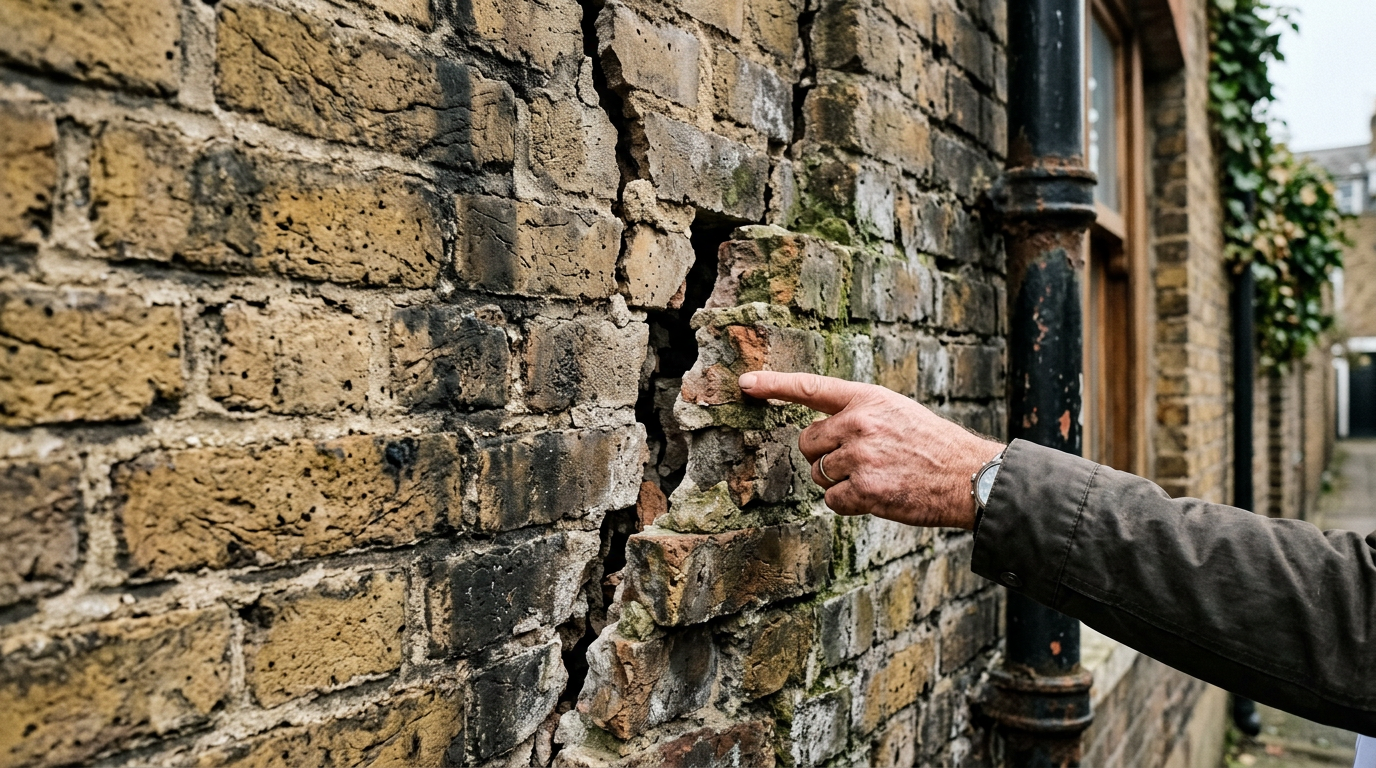
A CR3 on the pointing to a rear chimney stack is very different from a CR3 on the main loadbearing walls. A CR3 on the flat roof of a lean-to extension is very different from a CR3 on the main roof structure. When reading the report, try to categorise the CR3 items by:
- Safety risk: Does the defect present a safety hazard? Structural instability, electrical hazards, gas issues — these must be addressed immediately.
- Consequential damage risk: If left unaddressed, will the defect get significantly worse and cause damage to other parts of the building? Active water ingress is the classic example — a leaking roof that isn't fixed leads to timber decay, which then leads to ceiling collapse.
- Scale and cost: A CR3 defect that will cost £500 to repair is very different from one that will cost £50,000.
If you're unsure how to categorise any of the findings, call your surveyor. A good surveyor will always be willing to talk you through the report over the phone or in a meeting. At Camden Surveyors, we include a verbal debrief as standard with every Level 3 survey.
Using the Survey Report in Price Negotiations
Your survey report is a negotiating tool as well as a condition assessment. If the report reveals significant defects that weren't apparent from the initial viewing — and this is more common than you might think — you have the basis for a price renegotiation.
The standard approach is to obtain indicative quotes from contractors for the most significant works and then approach the vendor with a price reduction request (or, alternatively, a request for the vendor to carry out specific repairs before exchange). In a stable market, most vendors are prepared to negotiate rather than risk losing the sale. In a very strong sellers' market, your leverage is reduced — but the information is still valuable because it helps you decide whether to proceed at all.
Some important points about using survey reports in negotiations:
- Don't send the full report to the vendor or their agent — it's confidential and addressed to you
- Summarise the relevant findings in a measured, factual way when requesting a reduction
- Focus on the significant, objective items rather than minor maintenance matters
- Be reasonable — a report that finds £15,000 of works doesn't necessarily justify a £15,000 price reduction, but it does justify a conversation
What to Do After Reading the Report
Having read and understood the report, your next steps will typically be:
- Call your surveyor to discuss any findings you don't understand or that concern you
- Obtain contractor quotes for the most significant defects (your surveyor may be able to recommend contractors or provide their own cost estimates)
- Decide whether to proceed, renegotiate, or withdraw from the purchase
- If proceeding, instruct your solicitor on any legal matters flagged in the report and ensure appropriate consents and guarantees are obtained on exchange
- Plan a maintenance schedule for the property that addresses the non-urgent items over time
A final thought: a survey report is not a reason not to buy — it's a tool for buying wisely. Almost every property, including new-builds, will have findings in a survey. What matters is that you understand what those findings mean, what they'll cost to address, and whether the property still represents good value in light of those costs.
Frequently Asked Questions
My survey came back with lots of Condition Rating 2s. Should I be worried?
Not necessarily. Condition Rating 2 means repairs are needed but they're not urgent. For any property over twenty years old, multiple CR2 items is entirely normal. What you're looking for is the number and severity of CR3 items, and whether any of the CR2 items are heading towards CR3 if not addressed promptly. Read each CR2 description carefully — some will be minor maintenance items, while others may be significant works that are just not yet at crisis point.
The surveyor said they couldn't inspect certain parts of the property. Is that normal?
Yes, it's common. Building surveyors carry out a visual, non-intrusive inspection. They can't lift floorboards, open up walls, or inspect areas that aren't safely accessible. Where access was limited, the report will note this as "NI" (Not Inspected) or "LI" (Limited Inspection). If important areas weren't accessible — particularly a loft space or under-floor void — it may be worth negotiating access for a further inspection, or factoring a risk allowance into your offer price.
Can I ask my surveyor questions after receiving the report?
Absolutely, and you should. Your survey report is paid for by you and serves your interests. Most surveyors are happy to talk through findings over the phone, and some (including Camden Surveyors) include a post-survey consultation as standard. If you need a written clarification of a specific point, you can request this — though some firms charge for written amendments beyond the original report scope.
What does it mean when the surveyor recommends a specialist report?
A recommendation for a specialist report means the surveyor has identified something that goes beyond their generalist expertise or that requires more detailed investigation than a visual survey allows. Common specialist reports include: drainage CCTV surveys, structural engineer assessments for movement or cracking, electrical installation condition reports (EICRs), gas safety certificates, asbestos surveys, and Japanese knotweed surveys. These typically cost between £150 and £600 each, and are almost always worth commissioning for the properties they're recommended on.
How much weight should I give to the surveyor's valuation versus the agreed price?
RICS Level 2 reports include a market valuation. If the surveyor's valuation is significantly below the agreed price, this is a meaningful data point — but it doesn't necessarily mean you're overpaying. Surveyors are, by training and professional obligations, conservative in their valuations. They rely on comparable evidence from recent sales, and in fast-moving markets, that evidence can lag behind actual prices. However, if the surveyor values the property at, say, £50,000 below the agreed price, that's a conversation worth having with your solicitor and mortgage lender.
Commissioning a Building Survey in Camden?
Camden Surveyors provides RICS Level 2 and Level 3 surveys across Camden and Central London. Our reports are written in plain English, and we always include a post-survey consultation to talk you through the findings.