 Robert Chen MCIOB, Senior Building Surveyor
Camden's Victorian and Georgian housing stock is beautiful — but renovating it requires patience, knowledge, and a healthy respect for the rules. I've worked on hundreds of residential renovation projects across the borough, and in that time I've seen the full spectrum: from smooth, well-planned refurbishments that added significant value and were a joy to deliver, to chaotic, under-planned projects that ended up costing twice the original budget and falling foul of planning enforcement.
The difference between the two is almost always about preparation. This guide lays out everything you need to think about before you start renovating a period property in Camden — from planning permission and listed building consent to party walls, structural work, and choosing the right contractor.
In This Guide
Before You Start: Getting the Survey Right
If you're buying a property with the intention of renovating, commission a full Level 3 Building Survey before exchange. This serves multiple purposes. It tells you what you're inheriting in terms of defects. It informs your renovation budget. It may reveal problems that change the scope of your project entirely — asbestos in the floor tiles, for example, or hidden structural movement that needs to be addressed before any cosmetic work can proceed.
Even if you already own the property and are planning to renovate, a pre-works survey and building condition report is worthwhile. It establishes a baseline against which any changes in condition can be measured — which matters both for insurance purposes and for any future sale or dispute.
Planning Permission in Camden
One of the most common mistakes homeowners make when renovating in Camden is assuming that because works are "just internal" or "relatively small," no planning permission is needed. This can lead to serious and expensive problems.
What Needs Planning Permission?
In Camden, the following works almost always require planning permission:
- Rear extensions beyond permitted development limits
- Side extensions (almost never permitted development in Camden due to high urban density)
- Roof alterations visible from the street, including dormers and raised party walls
- Changes to the use of all or part of the property
- Works to properties in Article 4 Direction areas where permitted development rights have been removed
- Works to listed buildings (requires listed building consent, not just planning permission)
Permitted Development in Camden
Camden has extensive Article 4 Directions in place, which remove permitted development rights across large parts of the borough. This means that works that would be permitted development elsewhere — such as rear extensions up to 3 metres in depth, or single-storey side returns — may require planning permission in Camden. Before assuming works are permitted development, check with Camden Council's planning department or commission a pre-application planning enquiry.
Building Regulations
Planning permission and building regulations approval are different things. Almost all structural works, extensions, changes to the roof structure, new bathrooms, electrical rewires, and boiler replacements require building regulations approval — regardless of whether planning permission is needed. Building regulations approval can be obtained either via a local authority building control application or through an approved inspector.
Listed Buildings and Conservation Areas
Camden has an unusually high concentration of listed buildings and conservation areas. The conservation areas cover large parts of Hampstead, Belsize Park, Primrose Hill, Bloomsbury, and the Camden Town terraces. This has significant implications for renovation projects.
Conservation Area Restrictions
In a conservation area, permitted development rights are further restricted. You'll need planning permission for:
- Cladding the exterior with stone, artificial stone, pebble dash, render, timber, plastic, or tiles
- Any alteration to the roof shape, including velux-style roof lights (in some areas)
- Demolition of a wall, fence, or gate over 1 metre high adjoining a highway
Listed Building Consent
If your property is a listed building — and a significant number of Camden's Georgian and Victorian properties are either listed in their own right or part of a listed group — you will need listed building consent for any works that affect the character of the building, internally or externally. This includes works like removing internal walls, replacing original windows and doors, and adding or removing decorative features.
Listed building consent applications require considerably more detail than standard planning applications, and the approval process can take longer. For significant works to listed buildings, we strongly recommend engaging a conservation architect or heritage consultant in addition to a building surveyor.
Party Wall Considerations
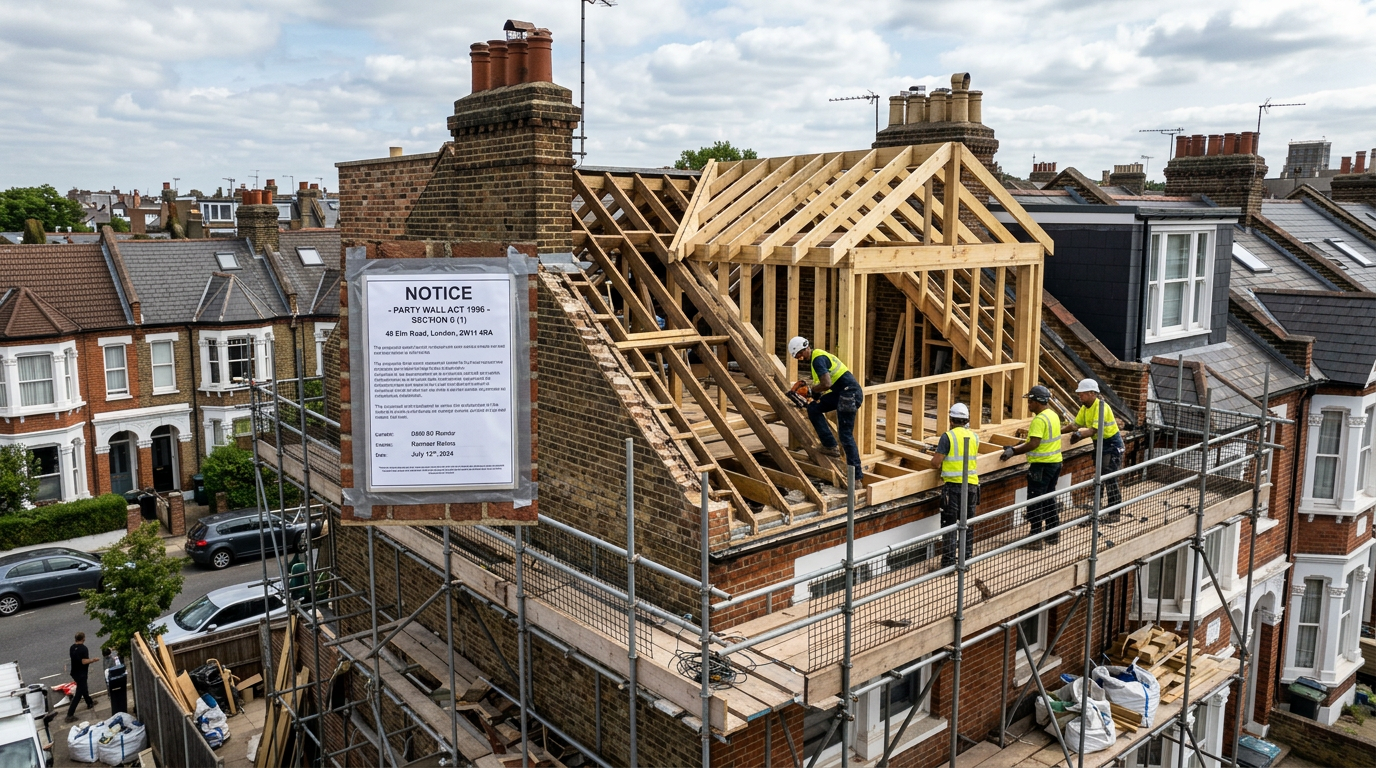
In Camden's densely built terraces, almost any significant renovation project will trigger the Party Wall etc. Act 1996. Works that commonly require party wall notices include:
- Loft conversions that involve work to the roof structure at the party wall
- Rear extensions where new foundations are dug close to the boundary
- Basement excavations
- Removal or modification of chimney breasts
- Any work to a shared (party) wall
Getting the party wall process right is essential — not just to comply with the law, but to protect you from claims by neighbours during and after construction. We strongly recommend reading our detailed party wall guide and our loft conversion and party wall article before starting any relevant works. For any project involving party wall matters, you will need to appoint a party wall surveyor.
Structural Works in Period Properties
Victorian and Georgian properties in Camden present specific structural challenges that are well worth understanding before you start work.
Loadbearing Walls
Many people undertaking internal renovations want to open up the ground floor — removing the wall between the front and back reception rooms, for example, or removing the kitchen wall to create an open-plan living space. In Victorian terraces, the internal walls are almost all loadbearing to some degree. Before removing any internal wall, you need a structural engineer to assess whether it's loadbearing and, if so, to design an appropriate steel beam or RSJ to carry the load above.
Basements
Basement conversions are common in Camden, and they can add significant value — but they're also one of the most technically demanding renovation types. Key considerations include: underpinning the existing foundations, waterproofing to Type A, B, or C BS 8102 standard, party wall notices (almost always triggered), drainage, ventilation, and structural support during excavation. A basement conversion in a Camden terrace typically costs between £80,000 and £200,000 depending on size and complexity.
Subsidence and Movement
As we discuss in our subsidence guide, many Camden properties show evidence of historic ground movement — particularly those on London clay soils. Before planning significant structural works, ensure any historic movement has been properly assessed and is either stable or has been addressed.
Updating Services: Gas, Electrical, Drainage
A full renovation is an ideal opportunity to bring services up to modern standards — and in many cases, you'll have little choice, since significant alterations can trigger mandatory upgrades under building regulations.
Electrical: If you're carrying out a full rewire (which is usually advisable in a property over forty years old where the wiring hasn't been updated), you'll need a Part P notification to building control and an EICR from a qualified electrician on completion. Budget approximately £6,000–£12,000 for a full rewire of a three-bedroom Victorian terrace.
Gas and heating: A new boiler installation or full central heating installation requires Gas Safe registered engineers and building regulations notification. Heat pump installations — increasingly popular as properties are upgraded for energy efficiency — may also require planning permission depending on location.
Drainage: Any changes to drainage — new bathrooms, extended kitchen, basement — need to be notified to building control and, in most cases, to Thames Water. A pre-works drainage CCTV survey is advisable to understand the condition of the existing drains before you start.
Choosing and Managing Contractors
Finding reliable contractors in London is genuinely challenging. Here's what I recommend based on fifteen years of observing renovation projects in Camden:
- Get at least three quotes for any significant work, and make sure they're quoting on the same specification
- Check credentials: Gas Safe registration for gas work, NICEIC or NAPIT membership for electrical work, and for general builders, check for Federation of Master Builders membership or similar
- Ask for references and follow them up — not just an email but a phone call, and if possible a visit to a previous project
- Use a proper contract — the JCT Minor Works Building Contract is suitable for most residential renovation projects and protects both parties
- Agree a payment schedule tied to completion milestones, not time periods — never pay more than 10–15% upfront
- Confirm PI (professional indemnity) and public liability insurance before work starts
Renovation Cost Guide for Camden Period Properties (2025)
| Work Type | Approximate Cost (2025) |
|---|---|
| Full rewire (3-bed terrace) | £6,000 – £12,000 |
| New boiler installation | £2,500 – £5,000 |
| Rear single-storey extension (6m²) | £35,000 – £65,000 |
| Loft conversion (dormer) | £60,000 – £100,000 |
| Basement conversion | £80,000 – £200,000 |
| New bathroom | £8,000 – £20,000 |
| New kitchen | £15,000 – £50,000+ |
| Roof replacement (full) | £18,000 – £40,000 |
| Damp proofing and remediation | £1,500 – £15,000 |
| External wall insulation / EWI | £8,000 – £25,000 |
Note: All costs are approximate and will vary depending on specification, contractor, and site conditions. These figures are based on 2025 London market rates. Obtain detailed quotes from qualified contractors before committing to any works.
Frequently Asked Questions
Do I need an architect for a Camden renovation?
Not always — but for significant works, particularly those involving planning permission, structural changes, or listed building consent, an architect or architectural designer with experience in Camden's planning regime is invaluable. For smaller projects like reconfigurations and redecoration, a building surveyor can often manage the project management and compliance aspects without a separate architect. We can advise on the appropriate professional team for your specific project.
How long does planning permission take in Camden?
For a standard householder planning application (extension, dormer, etc.), the statutory determination period is eight weeks. In practice, Camden Council often takes closer to twelve weeks, and complex applications — particularly for listed buildings or in sensitive conservation areas — can take six months or more. Factor this into your project timeline and don't start any works that require planning permission before the consent is granted in writing.
Can I do my own building work in my Camden property?
You can carry out some works yourself, subject to the same planning, building regulations, and party wall requirements as a professional contractor. You cannot legally carry out Gas Safe-regulated gas work unless you are Gas Safe registered, and should not carry out electrical work beyond minor tasks unless you're competent to sign it off or willing to have it inspected and certified. For structural works, even where self-building is legally permitted, we strongly recommend employing qualified professionals to design and oversee the work.
Will a renovation increase the value of my Camden property?
It depends enormously on what you do and how well it's executed. In Camden's high-value market, well-planned extensions, loft conversions, and high-quality refurbishments can add significant value — often more than their cost if the overall specification is appropriate for the area. Poorly planned or poorly executed work can actually reduce value — particularly if it involves planning breaches, uncertified structural work, or alterations that compromise the character of a period property. We generally advise spending money on getting the basics right (roof, damp, services) before investing in decorative improvements.
Planning a Renovation in Camden?
Camden Surveyors can provide pre-renovation building surveys, party wall services, project monitoring, and building regulations consultancy. Get in touch for a free, no-obligation conversation.